
Illustrative only. This image does not depict a specific property, provider, or quote.
If you're trying to find out what crime scene cleanup costs, or the cost of crime scene cleanup for a specific situation, the honest answer is that there's no single number, and any site that gives you one without seeing the property is guessing. This guide explains what actually drives a quote, what published ranges from real providers look like, and why a written quote matters more than a number you find online.
Call (786) 628-8505 to talk through your situation. Your call is forwarded through our referral partner to a call center, available 24/7. The call center asks for the ZIP code where you need the cleanup and connects you to a biohazard cleanup company that serves that area. We are a referral service, not a cleanup company. Calls may be recorded. If anyone is in danger or hurt, call 911 first.
We are paid a referral fee for qualified calls. You do not pay us for the call.
Service depends on your ZIP code; in some areas we may not be able to connect you.
Why there's no single answer
Biohazard Cleanup Connect is a referral service, not a cleanup company, so we don't quote prices ourselves and we won't present a figure as our own. Crime scene cleanup cost depends on what is actually involved at a specific property, and that varies enormously from one situation to the next. That is exactly why a provider needs to see the space before giving a real number. For a wider look at the work itself, see Crime Scene Cleanup: What Happens and Who to Call and Biohazard Cleanup: What It Is and Who to Call.
What actually drives a crime scene cleanup quote
A few factors come up again and again across published provider pricing guides and industry descriptions of this work, including Bio Recovery's cost guide (checked on November 5, 2026):
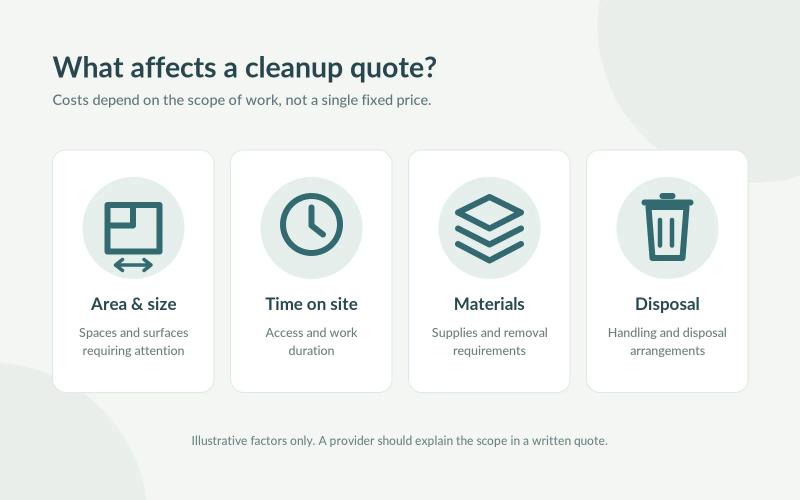
- Size of the affected area. A small, contained spot is a different job from contamination that has spread across a room or into multiple rooms.
- Time since the event. The longer an area goes untreated, the more material can migrate into porous surfaces, which generally increases scope.
- Materials that need to be removed. Flooring, drywall, subfloor, or furniture that has absorbed contamination often has to be removed and disposed of as regulated waste rather than cleaned in place. Removal and replacement add cost that surface cleaning alone wouldn't.
- Odor treatment. When decomposition or prolonged exposure is involved, additional steps to address odor in porous materials can add to the scope.
- Waste hauling and disposal. Regulated medical waste has to be disposed of in line with the rules that apply where the work is done, and the volume of waste affects what that costs.
- Number of technicians and time on site. Larger or more complex jobs typically require more people and more hours, which affects labor cost regardless of how a provider structures its pricing.
- Location. Medical waste rules are set mainly at the state level and differ from state to state, and provider availability in a given area affects pricing too. A quote in a major metro area may differ from one in a more rural location for reasons that have nothing to do with the job itself.
- Timing. A provider responding outside normal business hours may price that differently than a scheduled daytime appointment. This varies by company and should be confirmed upfront rather than assumed.
These factors are also why crime scene cleanup is priced differently from general cleaning in the first place. Providers handling this work carry costs that a standard cleaning company doesn't: protective equipment and training for people who may be exposed to blood, disinfectants suited to blood and other potentially infectious materials, and compliance with waste rules that apply specifically to regulated medical waste. Part of what a quote reflects is that safety and regulatory overhead, not just labor and supplies.
Where this is a matter of rule, the sources are official:
- Worker protection, disinfection and regulated waste: OSHA, Bloodborne pathogens standard, 29 CFR 1910.1030. It requires employers to provide protective equipment where employees have occupational exposure, to decontaminate surfaces with an appropriate disinfectant after contact with blood or other potentially infectious materials, and to dispose of regulated waste in accordance with applicable federal, state and local regulations. Checked on November 5, 2026.
- Who sets medical waste rules: U.S. EPA, Medical Waste. EPA states that medical waste is primarily regulated by state environmental and health departments and that state programs differ significantly from each other. Checked on November 5, 2026.
"How much does biohazard cleanup cost per hour?"
This is one of the most commonly searched cost questions in this space, and it deserves a straight answer. Some third-party guides publish hourly figures, but crime scene and biohazard cleanup scope depends so heavily on the factors above (size, materials, disposal volume) that many providers assess the property first and quote the project as a whole. Bio Recovery, for example, publishes project-level ranges and says an on-site assessment is often necessary to give an accurate estimate (checked on November 5, 2026). If you see a flat hourly figure quoted online without reference to a specific provider's own published pricing, treat it as a rough estimate rather than something you can rely on for your situation. The only number that matters is the written quote a provider gives you after seeing the property.
What published provider ranges actually look like
Rather than inventing a figure, here is what one real provider has published. Bio Recovery, a biohazard remediation company, states on its own site that "biohazard cleanup typically costs between $1,500 and $25,000+, depending on the type of contamination, the size of the affected area, and the level of remediation required." Its page lists project-level examples: small blood cleanup at "$1,500 – $3,000," trauma scene cleanup at "$2,500 – $7,500," and an advanced decomposition scenario at "$10,000 – $25,000+."
Source: Bio Recovery, How Much Does Biohazard Cleanup Cost? 2026 Guide, biorecovery.com. Checked on November 5, 2026.
This is one provider's own published pricing, for its own market. It isn't a quote for your situation, and ranges like this vary by company and location. It's included here as an example of a sourced range, not as a number you should expect to pay. If we reference a specific provider's pricing elsewhere on this site, we'll always cite that provider's own page and the date we checked it, the same way.
Why a written quote matters
Illustrative only. This image does not depict a specific property, provider, or quote.
Whatever a provider's published range looks like, the number that actually matters is the written quote for your specific property. Before authorizing any work, it's worth asking a provider:
- What's included in this quote, and what would be billed separately?
- Does this account for materials that might need to be removed once work begins, or could the scope change?
- How do you handle regulated waste disposal fees? Are they included, or itemized separately?
- Can you provide documentation I can use for an insurance claim or victim compensation application?
A provider who won't put a quote in writing, or who pressures for payment before explaining what's included, is worth a second look.
Who pays, and what else to check
Cost is one part of the picture. Who pays is a separate question, and our guide Biohazard Cleanup Costs, Insurance and Who Pays covers how homeowner's or renter's insurance and crime victim compensation programs can fit in, with links to the official program pages. Before hiring anyone, confirm the company's credentials, scope and pricing directly with the provider. We do not check the companies your call reaches, so that confirmation is yours to make. The guide Crime Scene Cleanup: What Happens and Who to Call covers what to ask anywhere.
Call (786) 628-8505 to talk through your situation. Your call is forwarded through our referral partner to a call center, available 24/7. The call center asks for the ZIP code where you need the cleanup and connects you to a biohazard cleanup company that serves that area. We are a referral service, not a cleanup company. Calls may be recorded. If anyone is in danger or hurt, call 911 first.
We are paid a referral fee for qualified calls. You do not pay us for the call.
Service depends on your ZIP code; in some areas we may not be able to connect you.